 Jiapin Industrial Park, 130 Guankou Middle Road, jimei district, Xiamen City
 gavin@frandchina.com

What are the characteristics of industrial sockets?
Xiamen Frand Intelligent Equipment Co.,Ltd. Professional non-standard automation equipment & hose clamp assembly machine manufacturer
Release time: 2025-05-29
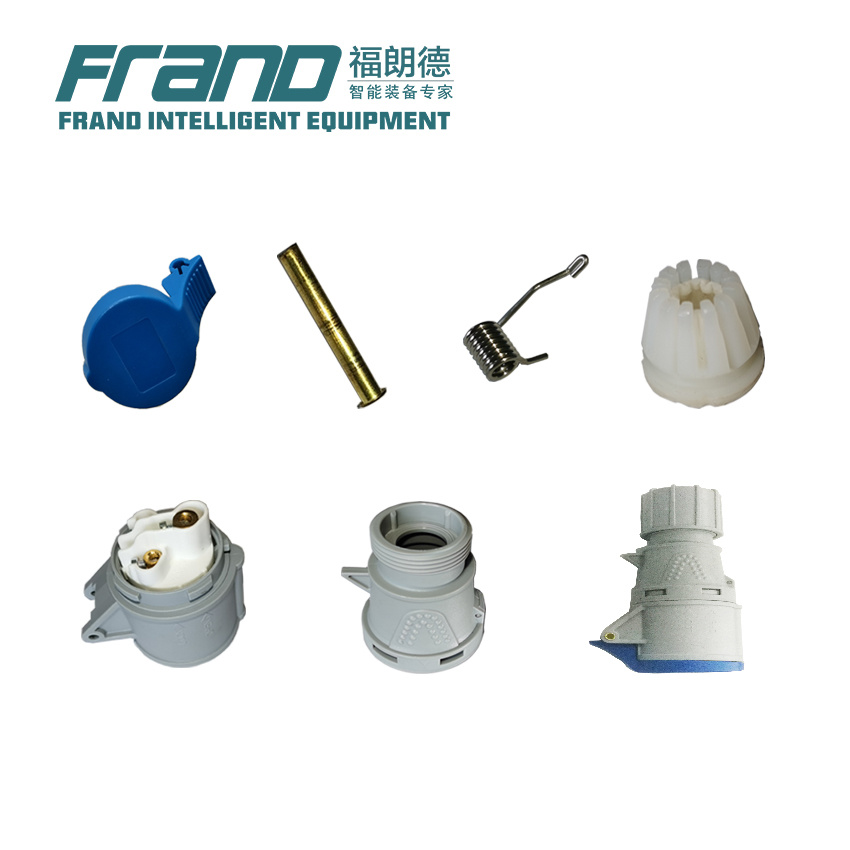
Industrial sockets, as the name implies, are suitable for industrial use. They are generally divided into 3-core, 4-core, 5-core, etc. The current is generally divided into 16A, 32A, 63A, 125A, 250A, 420A, etc. The protection level is divided into IP44 and IP67. It is relatively conventional. Usually, it is used with industrial plugs and connectors. So, what are the characteristics of industrial sockets?
What are the characteristics of industrial sockets?
1. High safety: Since each link in industrial production is complementary, once a problem occurs in one link, it is very likely to affect other links and cause particularly large losses. Therefore, industrial sockets need to have very high safety indicators, and often need to assist in the design of some protective measures.
2. Waterproof and electric shock protection functions: The design of these functions is also a proof of high safety.
3. Excellent sealing and retaining devices can better connect the plug and socket together, and are not easy to fall off.
4. Long service life: The long service life of industrial sockets is also to better ensure production safety.
5. Heat-resistant and flame-retardant: Industrial production machines are often turned on 24 hours a day, so the requirements for heat-resistant and flame-retardant sockets are often higher.
6. High versatility: The industries in the industrial field vary greatly. If the industrial socket is only designed for a certain industry, then both the production cost and the use cost are very high, so the sockets of various industries can often be used universally.
Is there a difference between industrial sockets and general sockets?
1. Different functions:
Household sockets can only be used for functions such as household appliances, and the output of the socket is also monotonous. Industrial plugs and sockets are reasonably designed, with a solid structure and quick disassembly and assembly. The diameter, number of poles, and grounding contact positions of products of different specifications are different, and only the same specifications can be plugged in to prevent wrong insertion.
2. Different ways of use:
Generally, sockets have one or more sockets, just plug them in.
Generally, industrial sockets use industrial sockets and connectors. The industrial plug is just a connector, which is connected to a plug and a socket respectively, and then connects them to each other.
3. Different load power:
The load of household sockets is relatively weak, most of them have a nominal rated voltage of 220V and a current of 10A. It is difficult for the rated current carrying capacity of household sockets to reach high power.
Industrial plugs and sockets can fully meet this requirement, and are generally divided into 3-core, 4-core, 5-core, etc. The current is generally divided into 16A, 32A, 63A, 125A, 250A, 420A, etc., and the protection level can be divided into IP44 and IP67.
What are the categories of industrial sockets?
Generally speaking, there are three types of industrial sockets: open sockets, concealed sockets and connectors. Under the category of concealed sockets, there are two types of branch sockets: concealed straight sockets and concealed oblique sockets.
Leave us a message.
For more product details, please fill in your personal information and we will contact you as soon as possible.

Whatsapp: 0086 18860022858
E-mail:gavin@frandchina.com
Web:www.xmfrand.com
Address: Jiapin Industrial Park, 130 Guankou Middle Road, Jimei District, Xiamen,China
Copyright © All Rights Reserved Xiamen Frand Intelligent Equipment Co., Ltd. Established in 2003, professional manufacturer of automatic assembly machinery. We own more than 60 national patents, focus on hose clamp assembly machine and non-standard automation equipment. Business scope: automatic assembling machine, welding machine, fastener production line, customized intelligent equipment.

SAF Coolest v1.2 设置面板 HJOSX-ZSQE-JVASE-ZXV
无数据提示
Sorry, the current column has no content for the time being.!
You can view other columns or returnHome Page